
Last year, United Oilseeds worked alongside NIAB to survey cabbage stem flea beetle (CSFB) larval levels in oilseed rape across the UK. Around 200 farmers submitted plant samples which were dissected by NIAB’s Colin Peters, helping to build a clearer national picture of larval pressure ahead of harvest.
The survey is being repeated in 2026, continuing the effort to better understand what’s happening inside OSR crops and how pressure varies between regions and seasons.
But growers don’t have to rely solely on national surveys to gain that insight.
With a few simple tools and a little time in the field, it’s possible to assess larval levels yourself. In the accompanying video, NIAB’s Colin Peters demonstrates just how straightforward the process can be, offering a practical way to see what’s happening inside your own crop.
Watch the demonstration here:
https://youtu.be/g0rIZZjnB6I
What’s in the kit list?
Not much at all:
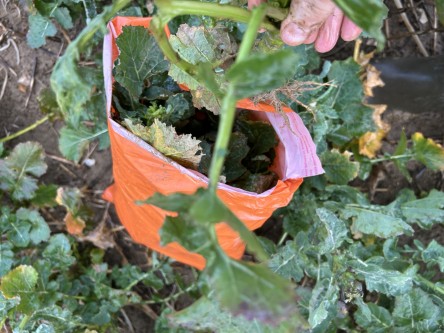
- A few £1 black buckets from a well-known DIY store (avoid orange — it’s harder to spot larvae once they’ve dropped)
- A small piece of chicken wire
- A little water
- A small amount of washing-up liquid
- And, of course, some OSR plants
That’s it. No specialist lab equipment. No expensive testing fees. Just a practical way to better understand your crop.
Why understanding larval levels matters
Monitoring larval levels is about informed decision-making. Last year’s survey largely confirmed lower cabbage stem flea beetle (CSFB) pressure, aligning with autumn yellow trap monitoring and helping to present a more positive picture for OSR plantings.
But seasons vary.
This year may show a similar trend, or it may highlight higher pressure in certain regions. Either way, having a simple, robust monitoring approach in place allows you to take a pragmatic view of crop potential and management decisions.
When larval numbers are low, it provides reassurance and confidence. You may not need to push seed rates towards the higher end, and you can often stick closely to your preferred drilling window, safe in the knowledge that establishment risk is reduced.
When numbers are higher, you are better equipped to respond early and appropriately, whether that’s adapting nutrition, adjusting plant growth regulation, or managing the canopy to support plant resilience. In these situations, considering higher seed rates or fine‑tuning drilling dates may be sensible options, helping to offset expected pressure and maintain crop potential.
Just as importantly, on-farm sampling builds knowledge over time. By repeating assessments each season, growers can benchmark fields, varieties and establishment approaches, and better understand how different strategies influence outcomes.
Turning information into action
Understanding what’s inside the stem helps you move from assumption to evidence. It supports a measured, practical approach, one that aligns with the industry’s shared goal of learning how to live with and manage CSFB rather than react emotionally to it.
Over the past few years, CSFB pressure has generally been much lower and far less of an issue for many growers. But continued monitoring ensures that this trend is recognised, acted upon, and built into long‑term decision‑making.
Where pressure is identified, growers can refer to the 10 Shared Strategies for OSR Success as part of the wider OSR Reboot initiative, focusing on establishment, resilience and plant health to support crop performance. Combined with clear larval data, these strategies help growers stay on top of CSFB and strengthen OSR’s bright, homegrown future.
The key message is simple: knowledge reduces uncertainty. And uncertainty has been one of the biggest challenges facing OSR in recent seasons.
By taking a few stems, a bucket and half an hour in the field, you gain clarity, and that clarity helps you farm more confidently.
ALSO WORTH A READ:
Limagrain’s Liam Wilkinson with his Top tips for managing forward oilseed rape crops this spring