
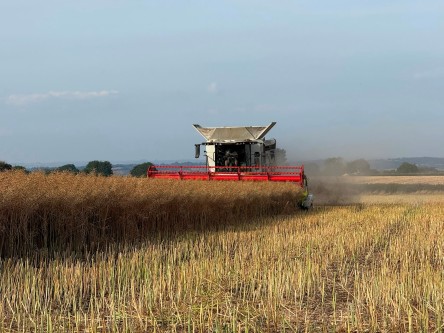
United Oilseeds is forecasting average UK oilseed rape (OSR) yields to exceed 4 t/ha for the first time in history, this harvest, potentially setting a new record for the crop and reinforcing the growing sense of optimism that has surrounded OSR over the past two seasons.
Based on the robust harvest data collected annually from members across the country, early indications suggest this year's crop could comfortably outperform long-term averages. For context, AHDB data shows the UK 10-year average OSR yield is around 3.3 t/ha, while the five-year average heading into the 2025 season was approximately 3.1 t/ha. AHDB reported a national average yield of 3.7 t/ha in 2025, one of the highest levels seen since 2017.
With England's harvest largely complete and Scotland rapidly drawing to a close, reports from growers across the UK point towards a crop that has consistently exceeded expectations.
A Standout Performer Despite Another Dry Season
The 2025-26 season will be remembered for prolonged dry weather across large parts of the country. Yet OSR has once again demonstrated one of its greatest strengths: resilience.
Its deep-rooting nature enables the crop to access moisture from deeper in the soil profile, helping maintain performance during periods of drought stress. Throughout the growing season, many United Oilseeds members reported crops looking exceptionally well, with some describing OSR as their best-performing break crop and, in several cases, the best-paying crop on the farm.
The strong yields being reported this harvest are further evidence that, when managed correctly, OSR remains one of the most rewarding crops in the rotation.
Better Management, Better Outcomes
Much of the recent success story can be attributed to growers adopting some or all of the industry's widely promoted Ten Strategies for Managing CSFB in Oilseed Rape.
A few years ago, cabbage stem flea beetle (CSFB) was the dominant conversation surrounding OSR. While the pest remains a challenge, growers today have a much broader toolbox available to help manage risk and establish successful crops.
As growers prepare for drilling, the first strategy, "Ditch the Date", is particularly relevant. With large parts of England and Wales currently experiencing drought conditions, calendar-based drilling has never been less important. Instead, establishing crops according to soil moisture and field conditions remains critical to achieving rapid, even emergence and helping crops grow away from early CSFB pressure.
The message is clear: growers who embrace a combination of proven management strategies are significantly increasing their chances of successful establishment and strong yields.
Preparing for the Rain
Another technique gaining attention is shallow post-harvest cultivation.
As part of the four-and-a-half-year CSFB Research+ project, Colin Peters and the Niab team continue to investigate whether light cultivation immediately after harvest can help disrupt flea beetle populations developing within the soil and reduce adult emergence later in the season. The latest research is promising and suggests a reduction in emerging adults by 50-80%
While extremely dry conditions have made cultivation difficult in some areas, many growers have nevertheless opted to create a shallow tilth. In many cases, the primary aim has not been CSFB management, but ensuring that when rainfall eventually returns, water infiltrates the soil rather than running off hard, capped surfaces.
Whether adopted for moisture management, pest control or both, these approaches reinforce a broader point: the industry now has a growing suite of tools that can help growers manage CSFB risk and rebuild confidence in OSR production.
Genetics Are Really Starting to Show Their Value
The impact of modern varieties is also becoming increasingly apparent.
For years, Scottish growers have demonstrated the yield potential that can be unlocked when strong genetics, breeding innovation and sound agronomy work together. Largely spared the levels of CSFB pressure experienced by English growers, they have consistently benefited from advancements in varietal performance that are now becoming increasingly evident further south. As English growers move beyond the peak CSFB years, improved varieties are increasingly being given the opportunity to realise their full yield potential.
At the same time, the pace of genetic progress continues to accelerate. Competition between breeders remains intense, driving significant investment into research and development and resulting in a steady stream of new, higher-performing varieties coming through the pipeline. Enhanced vigour, stronger autumn development and increasingly robust agronomic packages are combining to push yields higher, helping explain why so many growers are reporting some of their best OSR crops for years.
A Valuable Hedge in Uncertain Markets
Beyond agronomy, OSR continues to offer important risk management benefits.
Unlike wheat, barley and oats, which track UK feed wheat markets, OSR follows different market fundamentals and is more closely linked to European rapeseed markets and the wider energy sector because of its role in biofuel production.
That distinction can provide valuable diversification within a farm business. While agricultural commodity markets often move together, they do not always do so. At a time when feed wheat markets have faced sustained pressure and limited upside, rapeseed has often followed a different trajectory, reflecting its own supply and demand dynamics and underlining the benefits of maintaining exposure to a broader mix of market drivers.
For many growers, OSR remains one of the few crops capable of providing both rotational benefits and meaningful market diversification.
More Than Just a Break Crop
Strong yields are only part of the story.
As the first major crop harvested each season, OSR spreads workloads and allows field operations to begin earlier. It creates valuable breathing space before the main cereal harvest and ensures grain stores are emptied and ready for incoming crops.
The crop also delivers important cash flow advantages. UK demand for rapeseed remains close to 2 million tonnes annually, meaning significant imports are still required to satisfy domestic consumption. Its status as a freely traded commodity provides growers with marketing flexibility and the opportunity to generate income earlier in the harvest period.
OSR also plays a unique role in nutrient management. Digestate, slurry and specialist food waste products can be applied to OSR during the autumn, providing a highly effective route for recycling nutrients that cannot be utilised in the same way on cereal crops. For livestock and mixed farms, that remains a significant economic and environmental advantage.
Looking Ahead
After several challenging years, the mood around oilseed rape has changed noticeably.
Higher-performing varieties, improved understanding of CSFB management, stronger establishment strategies and favourable market dynamics are all helping restore confidence in the crop. If harvest results continue on their current trajectory, with average yields exceeding 4 t/ha, 2026 may well be remembered as the season that confirmed OSR's place as one of the most valuable and resilient crops in the UK rotation.
For many growers, the evidence is becoming increasingly difficult to ignore: oilseed rape is delivering once again.
Picture courtesy of Mr S Walker, Somerset